
CASE STUDY 03 / 04
Local-first AI Agent Workspace
A privacy-aware AI workspace that combines local models, tool orchestration and agent workflows while keeping sensitive data on-device by default.
This case separates the implemented structure, my personal contribution and the boundary of what can be shown publicly.
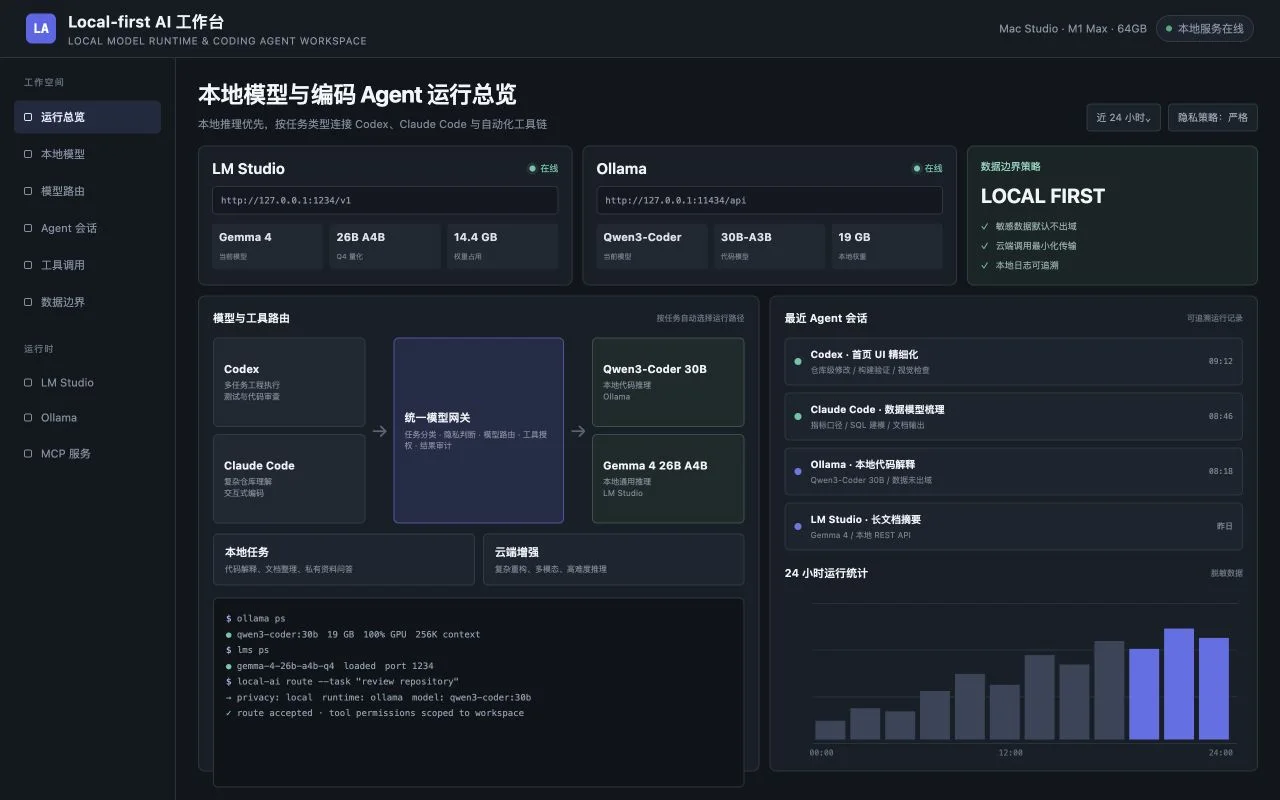 Anonymized reconstruction
 01 System Narrative
Problem, structure and delivery.
Operating problem
Cloud AI tools are capable, but default data export creates privacy, reliability and control constraints. Sensitive work cannot always be sent to an external service.
Delivery path
Established explicit data boundaries and layered routing: routine tasks stay on local runtimes, while only tasks that genuinely need stronger models are minimized and routed externally.
System structure
Ollama and LM Studio provide local inference, a gateway owns model and tool routing, agents decompose and execute tasks, and sensitive data remains on-device by default.
02 Decision Record
The trade-off behind the interface.
- Constraint
- Sensitive data could not be exported by default. Local models varied in quality and speed, stronger cloud models still had legitimate uses, and the toolchain needed to remain replaceable.
- Alternatives considered
-
- 01 Route every task to cloud models
- 02 Operate entirely offline
- 03 Route by data boundary and task difficulty
- Why this choice
- Chose a local-first layered architecture in which local runtimes handle routine work, a gateway owns model and tool routing, and only necessary tasks leave the device after data minimization.
- My contribution
- Independently designed model selection, runtime configuration, routing rules, tool orchestration, agent workflows and failure recovery, then calibrated the system with real tasks.
- Result and reuse value
- Routine work stays local while difficult tasks can still reach stronger models. Models and tools remain replaceable rather than locking the workflow to one provider.
- Public evidence boundary
- The public interface is reconstructed from the real toolchain and excludes local paths, accounts, conversations, document contents and private data.
03 Impact
What remained after delivery.
- Kept routine AI work on-device by default
- Made the privacy-versus-capability trade-off explicit and controllable
- Created reusable local agent workflows with recoverable execution
- Reduced dependence on a single cloud model or vendor
Next Case
Engineering Evaluation System for AI Tools