
CASE STUDY 01 / 04
Contract Profitability Management System
A contract-level operating intelligence system that reconciles revenue, cost, collection and delivery data into one traceable profitability model.
This case separates the implemented structure, my personal contribution and the boundary of what can be shown publicly.
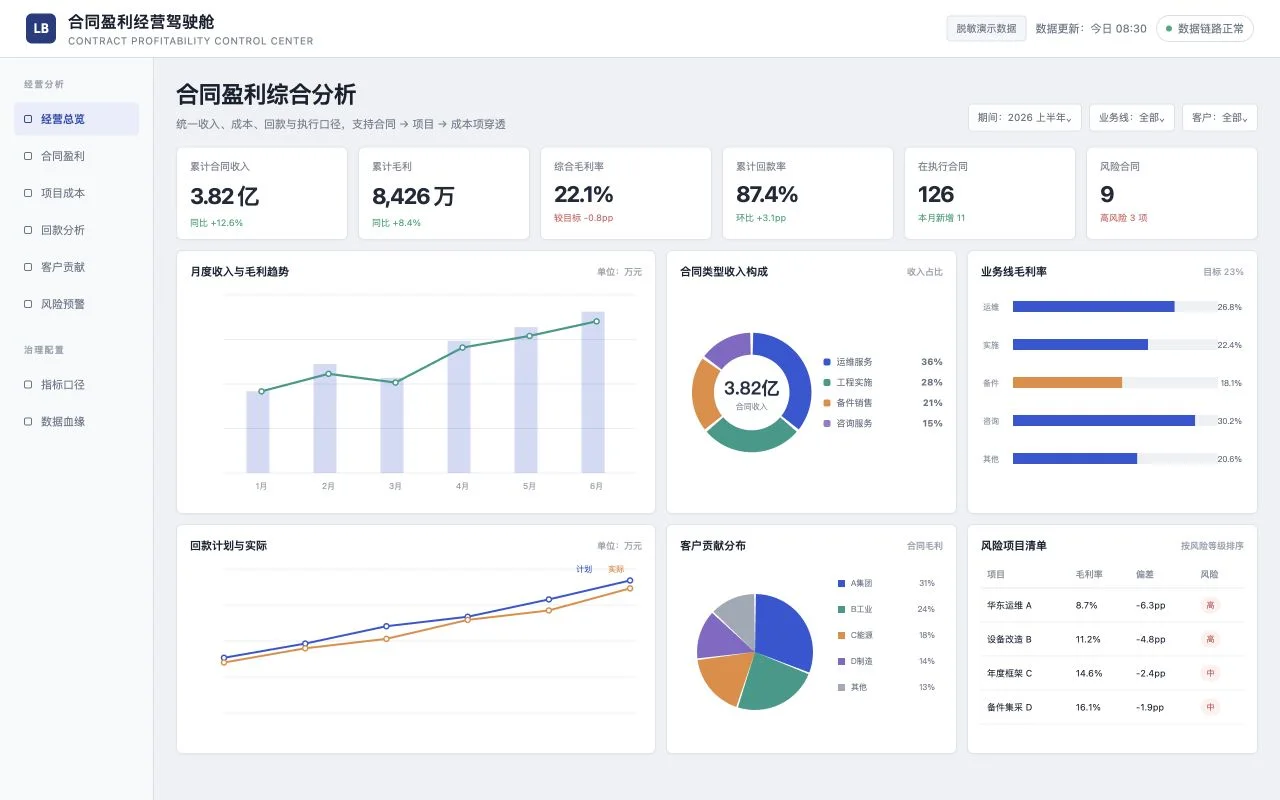 Anonymized reconstruction
 01 System Narrative
Problem, structure and delivery.
Operating problem
The company operated by contract, while revenue, cost, collection and delivery data lived in separate business, project and finance systems. Inconsistent definitions made monthly results slow to reconcile and difficult to trace.
Delivery path
Defined the operating metrics and ownership boundaries first, then used the contract as the analytical key connecting projects, customers, revenue, cost and collection. The decision interface was built only after traceability existed in the model.
System structure
Business, project and finance systems feed a governed layer for contract, customer and project master data. A contract–project–cost model supports Power BI views for operating overview, drill-down and exception analysis.
02 Decision Record
The trade-off behind the interface.
- Constraint
- Revenue, cost, collection and delivery data were split across systems with inconsistent definitions, while every management indicator still needed a path back to its source.
- Alternatives considered
-
- 01 Continue assembling monthly reports
- 02 Reconcile the logic inside the BI layer
- 03 Govern the definitions first and build a contract-level operating model
- Why this choice
- Defined the metrics and ownership boundaries first, used the contract as the central key, and kept complex calculation logic in the governed model rather than the presentation layer.
- My contribution
- Led metric governance, the contract-level model, warehouse layers, dashboard design and acceptance rules while aligning business, finance and IT stakeholders.
- Result and reuse value
- Created a traceable path from management indicators to contracts, projects and cost sources, with a reusable structure for adding future operating views.
- Public evidence boundary
- The public interface is reconstructed from the implemented business structure using demonstration data. Company, customer, contract and financial identifiers are not disclosed.
03 Impact
What remained after delivery.
- Reconciled revenue, cost and delivery data around contract-level definitions
- Replaced disconnected summaries with a traceable drill-down path
- Supported operating views by contract, customer, project and business line
- Kept each indicator connected to its source and calculation rule
Next Case
Digital Operations Analytics for Industrial Services